Lab notes · GPU unlock · Matched comparison update
In one matched dense-GEMM experiment, BF16 median throughput moved from 67.61 to 106.34 TFLOP/s. FP16 and TF32 also measured higher; strict FP32 did not. We then cold-returned to stock and measured the control again.
Measured GEMM comparison, not an application-speed claim. B/A1 throughput changes were +57.29% in BF16, +51.36% in FP16, +60.23% in FP32 with TF32 enabled, and -0.97% in strict FP32. All four stock-return controls were within 1.8% below their fresh stock A1 values. These observations do not establish a clean causal gain, model/render/game performance, energy savings or long-duration stability.
The matched A1 below is a fresh stock measurement from this comparison. It is not the earlier 67.58 TFLOP/s stock-only pilot retained in the historical note. One bounded phase was measured in each state, with the same reviewed numeric harness, 8192-square inputs, seed, precision settings and unchanged 300 W cap.
The completed A1 / B / A2 comparison
A1 is the verified original-stock cold boot; B is the single verified unlocked cold boot; A2 is the verified original-stock cold return. All use the same reviewed harness bytes, hardware, installed driver/kernel/runtime and 300 W cap.
No precision case crosses the predeclared ±5% stock-return drift flag; this does not establish causal isolation.
Skip comparison chart to equivalent data tables
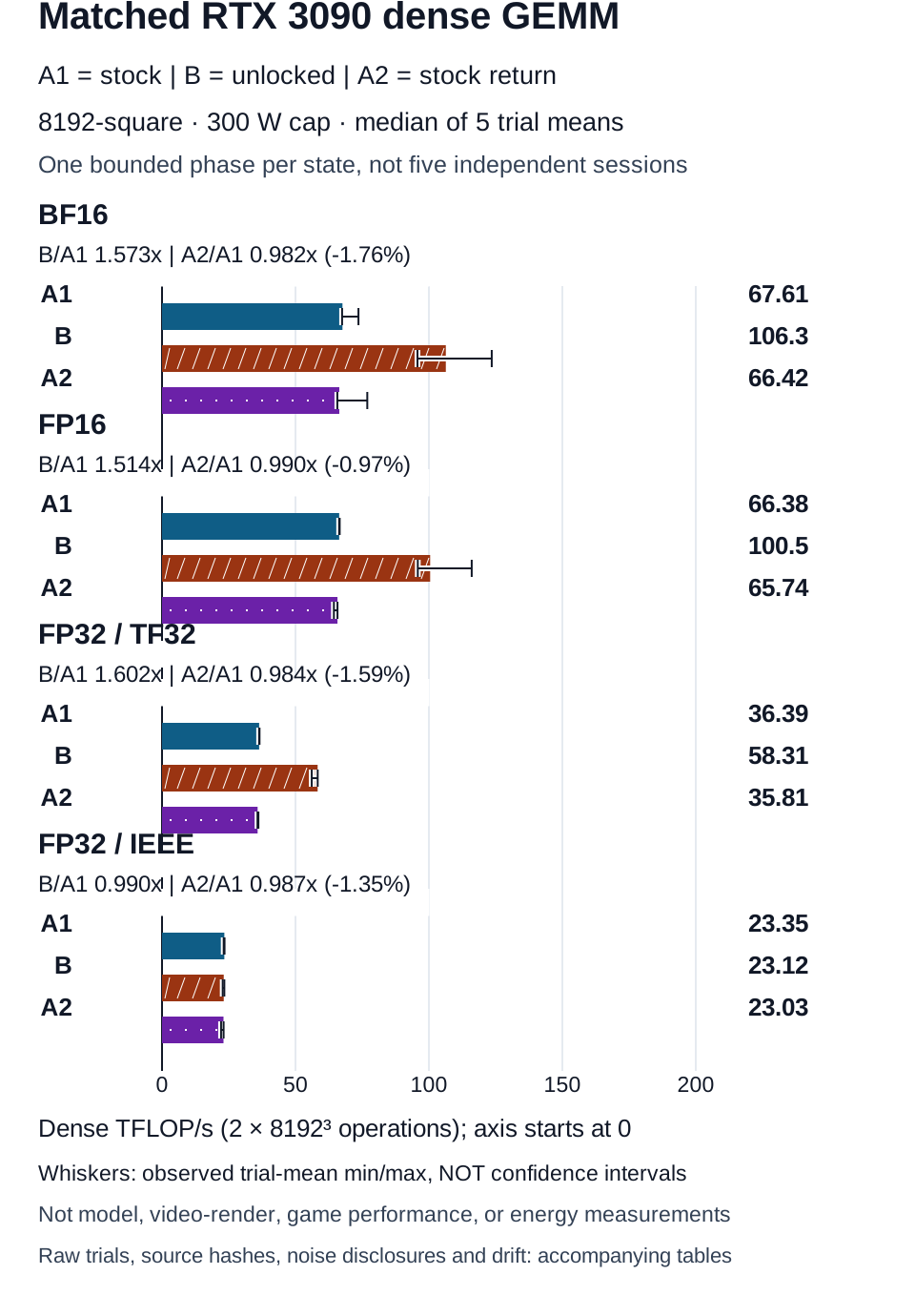
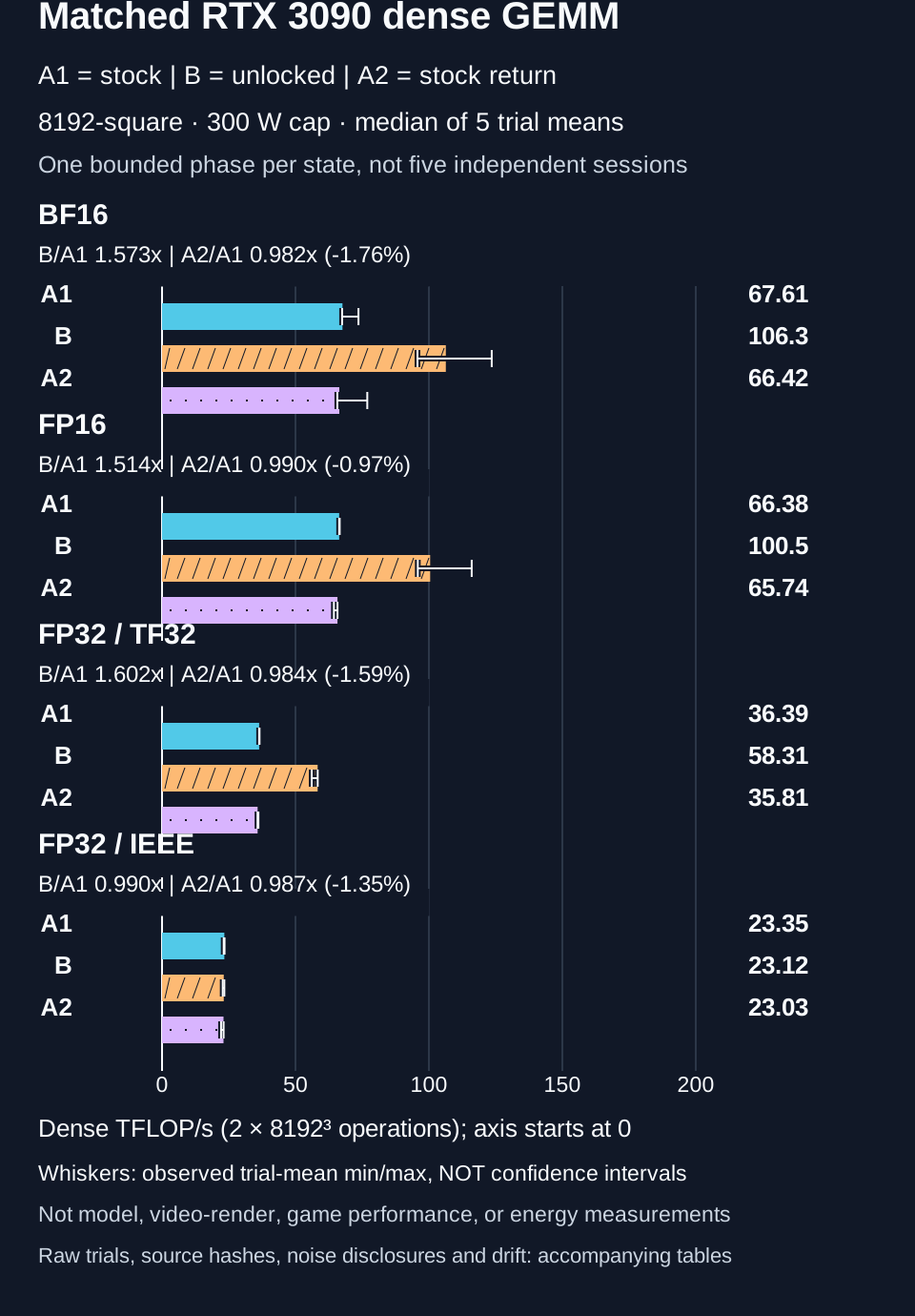
Throughput ratios and stock-return drift
| Precision | B / A1 | A2 / A1 | Stock drift | Interpretation |
|---|---|---|---|---|
| BF16 | 1.572857× | 0.982432× | -1.7568% | Within the predeclared ±5% drift flag threshold |
| FP16 | 1.513583× | 0.990347× | -0.9653% | Within the predeclared ±5% drift flag threshold |
| FP32 / TF32 | 1.602263× | 0.984110× | -1.5890% | Within the predeclared ±5% drift flag threshold |
| FP32 / IEEE | 0.990310× | 0.986514× | -1.3486% | Within the predeclared ±5% drift flag threshold |
View exact phase values and all 60 trial means
All measured phase values and trial means
| Precision and phase | Median milliseconds / GEMM | Dense TFLOP/s | Observed trial-mean min–max TFLOP/s | Five trial means, milliseconds / GEMM (recorded order) |
|---|---|---|---|---|
| BF16 — Stock A1 | 16.2628263 | 67.6088897 | 67.4701996–73.6027739 | 14.9384537, 16.1464208, 16.2642136, 16.2628263, 16.2962557 |
| BF16 — Unlocked B | 10.3396695 | 106.339146 | 95.716335–123.54167 | 8.89992523, 11.3451729, 11.487189, 10.3396695, 10.321195 |
| BF16 — Stock return A2 | 16.5536423 | 66.4211301 | 65.6856732–76.908659 | 14.2963308, 16.738987, 16.5608101, 16.5536423, 16.4461225 |
| FP16 — Stock A1 | 16.5638822 | 66.3800681 | 66.368956–66.5707496 | 16.5201925, 16.5666555, 16.5164375, 16.5638822, 16.5642242 |
| FP16 — Unlocked B | 10.9434878 | 100.471773 | 95.8363812–116.038378 | 9.47541364, 11.4727999, 11.0216535, 10.9410985, 10.9434878 |
| FP16 — Stock return A2 | 16.7253329 | 65.7392971 | 64.3989107–65.7446603 | 17.0734507, 16.7700475, 16.7253329, 16.7253329, 16.7239685 |
| FP32 / TF32 — Stock A1 | 30.2138036 | 36.3910364 | 36.3819965–36.533066 | 30.0963415, 30.1978022, 30.219958, 30.2138036, 30.2213109 |
| FP32 / TF32 — Unlocked B | 18.8569603 | 58.3079993 | 56.0964337–58.3282238 | 19.6003838, 18.9685758, 18.8549118, 18.8504219, 18.8569603 |
| FP32 / TF32 — Stock return A2 | 30.7016525 | 35.8127833 | 35.7691369–36.1111787 | 30.4479574, 30.4984639, 30.7016525, 30.7391154, 30.7370656 |
| FP32 / IEEE — Stock A1 | 47.0920512 | 23.3481363 | 23.1049703–23.4214564 | 46.9446309, 47.0847982, 47.1592967, 47.0920512, 47.5876668 |
| FP32 / IEEE — Unlocked B | 47.5528514 | 23.1218864 | 22.733837–23.3441122 | 47.1001689, 47.3537801, 47.5579732, 47.5528514, 48.3645426 |
| FP32 / IEEE — Stock return A2 | 47.7358093 | 23.0332667 | 22.1171185–23.0693927 | 47.7358093, 47.7081909, 47.7409261, 47.6610565, 49.71315 |
Noise and temperature disclosures
| Phase | Last temperature | Graphics-client observation |
|---|---|---|
| Stock A1 | 64 °C | Not proven idle (some activity counters unavailable) |
| Unlocked B | 66 °C | Not proven idle (some activity counters unavailable) |
| Stock return A2 | 68 °C | Not proven idle (some activity counters unavailable) |
Limitations
- One bounded phase per state; the five trial means are not five independent benchmark sessions.
- Observed trial min/max whiskers are not confidence intervals.
- Graphics-client activity can be unobservable; this is not a proof that all graphics clients were idle.
- Clocks and temperatures are not assumed identical because the power cap is unchanged.
- The 300 W limit is a power cap, not measured energy consumption.
- Dense GEMM throughput does not establish model, video-render, or game performance or prove the unlock mechanism.
- The small deterministic numeric sanity check is not a full 8192-square error audit.
- An absolute stock-return drift above 5% is flagged; it prevents treating B/A1 as a clean isolated improvement.
Method, platform, source hashes and raw data
gpu model: NVIDIA GeForce RTX 3090; driver version: 595.99.02; kernel release: 7.0.0-38-generic; torch version: 2.13.0+cu130; cuda runtime: 13.0
The numeric inputs were checked against preserved phase receipts, matching platform metadata and separate cold-boot evidence. These hashes identify the source records; they are integrity references, not independent certification.
- A1 numeric receipt SHA-256:
2372d4e76968d67a9923b1e789ffcaf70f8c38c4cd633e2afedc6f834c64283b - B numeric receipt SHA-256:
ab63c9c76395a3f4b04eb35642240756647e588d4a5d3ea546386b1285a083c0 - A2 numeric receipt SHA-256:
f2fe0c55670f05ac11255d85558bd2a8458316668cd9218a9f6c7e199954f07d - harness sha256:
ff426b645399ae2e38f2d51cce57fb75d6752940beaca09c19d880ee9d52686f - verification sha256:
54183719c7902e5ae84d495ab530eb5de70b8a16ea153e271891d0869f32113d - comparison plan sha256:
4baa0f9f514d154a8ceae4b5f606e03b1658e529ab62b1ae57cb92d4caa51a49
Download equivalent public data and unrounded trial means (JSON).
Accessibility review limits: on the local reviewed article, numeric validation, rendered light/dark checks at 1440, 820, 390 and 320 CSS pixels, keyboard disclosure and table-scrolling checks, and a 200% computed-text-size stress check passed. The text-size stress check is not native browser zoom. A screen-reader pass, native text-only enlargement and true 400% browser zoom remain unverified; no WCAG conformance is claimed.
The return to stock matters
The experimental boot and selected GPU were verified before B. A separate cold return to the original stock boot path was then confirmed before A2, with the normal boot flags, no loaded unlock module, and the same driver, kernel, runtime and 300 W limit. Owner confirmation of physical power removal was separate from software boot checks.
The original renderer was restored after the measurements. Existing render jobs and their approved prompts, references, seeds and settings were preserved without replay or new render submissions. Temporary maintenance access was revoked and admission restored. This is a completed short numeric comparison and rollback check—not a claim that the process was error-free or that the hardware is proven stable over long use.
The stock boot files also have protected hash-verified backup copies. Successfully cold-booting the original stock path does not turn those copies into an independently restored-and-boot-tested fallback.
Historical record: the original stock-only note
Preserved earlier draft, not current test status. The text and figures inside this disclosure record the earlier stock-only pilot and planning state. Statements such as “unlocked performance unmeasured,” “no reboot,” and “the next proposed comparison” describe that earlier point in time and are superseded by the dated matched-results update above. The original title, prose, trial values and figure captions are retained; heading levels alone are adjusted for this archive.
Open the preserved October 25 stock-only draft and its four figures
Lab notes · GPU unlock · Part 1
RTX 3090 at 300 W: Our Stock Baseline Before the GPU Unlock
Our unchanged RTX 3090 delivered 67.58 TFLOP/s in BF16 GEMM. Here are the stock measurements, the five trial means behind each result, and the clear line between a baseline and an unlock success.
A substantial compute upgrade for a GPU you already own is a compelling idea. For anyone running local AI on an RTX 3090, it is the kind of development that makes you want to clear the evening and start testing.
Zagitta’s gpu-unlock project has that appeal. But there are three different stories here: the proposed mechanism, the performance other people have reported, and the evidence we collected on our own machine. Those stories should not be blended into one impressive-looking bar.
Stock measured; unlocked performance unmeasured. We completed one short stock-only numeric phase containing four precision cases. No unlock was installed and no reboot occurred. These are matrix-multiplication measurements, not rendering, full-model or unlock-speedup results.
Our measured stock baseline
At an unchanged 300 W power cap, median dense GEMM throughput was 67.58 TFLOP/s in BF16, 66.36 in FP16, 36.32 in FP32 with TF32 enabled, and 23.11 in strict FP32. The cap is a configured limit, not a measurement of average power consumption.

View our median throughput and timing values
| Precision | TFLOP/s | Milliseconds / GEMM |
|---|---|---|
| BF16 | 67.58 | 16.269 |
| FP16 | 66.36 | 16.569 |
| FP32 · TF32 enabled | 36.32 | 30.276 |
| Strict FP32 | 23.11 | 47.583 |
The five trial means—not five separate experiments
The workload used 8192 × 8192 matrix multiplication: three warm-up iterations per precision, followed by five timed trial means of three GEMMs each. Reduced-precision reductions were disabled for BF16 and FP16; the FP32 cases explicitly selected TF32-enabled or IEEE precision. Results below are times per GEMM, not total session duration.

View all five stock trial means
| Precision | Trial means, in recorded order |
|---|---|
| BF16 | 15.463, 16.106, 16.350, 16.269, 16.416 |
| FP16 | 16.525, 16.568, 16.569, 16.648, 16.713 |
| FP32 · TF32 enabled | 30.216, 30.212, 30.276, 30.451, 30.461 |
| Strict FP32 | 47.538, 47.583, 48.501, 47.179, 47.907 |
The phase recorded 3.161 seconds of CUDA-event work and 6.910 seconds of parent wall time through child exit. That wall time is not the duration of the backup and maintenance session. All four large outputs passed finiteness checks. A separate tiny 16 × 16 CPU-reference comparison reported maximum absolute error 0 for each case; that is not a full 8192 × 8192 numerical-error audit.
The renderer was temporarily isolated, but existing desktop graphics clients remained. Their activity was not proven idle. The short phase and its five trial means establish a measured starting point—not an exclusive-graphics benchmark, average-power result or long stability run.
What is actually being unlocked?
The project describes an early-boot Linux module that changes compute-related instruction-issue settings before NVIDIA’s normal driver takes control. It is not a GPU BIOS flash or a conventional driver upgrade. The documented target is Ampere RTX 30-series hardware; a broad headline mentioning the 2080 Ti or 4090 is not compatibility proof for those cards. Source: the project’s pinned README.
The important distinction is between an instruction-rate change and the speed of a complete application. A faster matrix operation is not a measurement of how much sooner an image, video, or model response finishes. That second claim requires another experiment.
Outside unlock reports are separate evidence
An outside report tested four RTX 3090s in one system at 225/250 W, with local claim fixes. Its reported BF16 gains were roughly 22–35%—not results from our 300 W rig.

View the reported chart values
| Card / cap | Before TFLOPS | After TFLOPS | Gain |
|---|---|---|---|
| 69 · 225 W | 54.4 | 67.8 | 24.63% |
| 6a · 225 W | 55.2 | 67.7 | 22.64% |
| 6d · 250 W | 58.3 | 78.5 | 34.65% |
| 6e · 225 W | 49.2 | 60.1 | 22.15% |
Method: 8192³ matmul, FP32 accumulation, five runs; Ubuntu 24.04 and NVIDIA open 610.57.04. The reporter observed lower clocks under the caps. No confidence intervals have been inferred.
We are deliberately not mixing these bars with the larger RTX 3090 Ti headline figures. The original Ti validation note describes a 450 W experiment with a modified driver and custom boot hook, before final source cleanup. That is different evidence from a turnkey validation of today’s stock-driver installer.
Our machine—and the work we can document
Our target is an RTX 3090 at an unchanged 300 W limit, running Ubuntu 24.04.4 LTS, kernel 7.0.0-38-generic and the NVIDIA 595.99.02 open driver. Existing renders and their approved prompts, references, seeds and settings had to remain untouched.
We pinned the source revision to af28cbb, compiled the module without a privileged installation, and generated the required assets in isolated staging. A successful build against our kernel headers is useful preparation. It is not proof that the unlock works on our hardware.
The stock-only runner created and hash-verified 13 actual stock boot-file backups. These are protected file copies, not an independently boot-tested fallback. Its unprivileged preflight also passed 154 synthetic checks of changed inputs, duplicate execution, timeouts, cleanup, source integrity and restoration logic. Those checks are separate from the GPU measurements above.
Appendix: the software-check counts

View our check counts
| Component | Checks |
|---|---|
| Runner and cleanup | 59 |
| Boot-file backup logic | 58 |
| Numeric harness | 26 |
| Preflight and integrity | 11 |
| Total | 154 |
What happened to the unlock test?
Boot ordering and an independently verified cold return to stock were not ready for activation, so we did not install the unlock or reboot. An earlier window closed without a stock measurement. A fresh stock-only window subsequently completed the short numeric phase reported here; it did not authorize an unlocked comparison.
The upstream tracker contains an Ubuntu initramfs ordering report in which the NVIDIA driver binds the card before the unlock can run. We did not reproduce that failure: the stock initramfs images we inspected lacked nvidia.ko. The report is a warning to inspect the actual boot path, not a diagnosis of our machine.
After measurement, the original active renderer state was restored and its empty native queue verified. All 20 stable job records were verified unchanged: 11 completed clips and nine submission-uncertain records, preserved without replay. The temporary admission gate was restored, its helper access revoked, and the owned loopback transports closed. Stock boot and service-file hashes remained unchanged. No unlock, new render submission or reboot occurred.
What the next graphs must prove
The next proposed comparison is A/B/A, under a new approved test window:
- A1: stock. Our short starting measurement now exists. A matched comparison will need repeated stock timings and appropriate correctness checks on the unchanged 300 W setup.
- B: unlocked. Only after boot ordering and recovery are verified, repeat the same workload and settings.
- A2: stock return. Cold-return to stock, verify the system state, and repeat the measurements to check whether the apparent difference survives the return.
We will need the same hardware, power cap, driver, runtime, inputs, precision and timing method, with power and temperature observations alongside performance. Any later claim about a real AI workflow will need its own controlled test; a matrix-multiplication result is not a substitute.
The outside evidence is promising enough to investigate. Our own evidence now establishes a stock baseline—not a speedup. No unlocked column exists yet, and outside results cannot fill it. The next useful claim must come from a matched comparison on this machine.